

Who said that life is not for amateurs? Ira Sachs’s new film, The Man I Love, is a testament to this statement. His main character, Jimmy, is a New York theater actor living out his final days in 1980s New York for reasons familiar to gay men of that era. He is one of many who will soon be gone. Nevertheless, Sachs’s new film does not focus on the corridor of death so much as showcase an entire room of life.
In some ways, The Man I Love is a one-man show. Rami Malek’s delicate portrayal of Jimmy is so enchanting that you simply want to be with him in every shot: as he rehearses his lines in the bedroom for an upcoming show, performs for a crowd of friends in his apartment, or involuntarily seduces you with his ever-moving eyes.
Yet, at the same time, the film boasts a stellar supporting cast whose members give Malek’s Jimmy the stage on which to shine: Tom Sturridge, powerful in his stillness and subtlety as Jimmy’s loyal partner, Dennis, and Luther Ford as Vincent, a beguiling new lover full of youth, innocence, and beauty.
The film invites you to spend a few days with these men and become part of a slowly forming love triangle. It offers no lessons or resolution. In his direction, Sachs is not a preacher. He simply paints a picture and invites you into the room with his protagonists to spend some time with them.
Read the full review on Medium.com
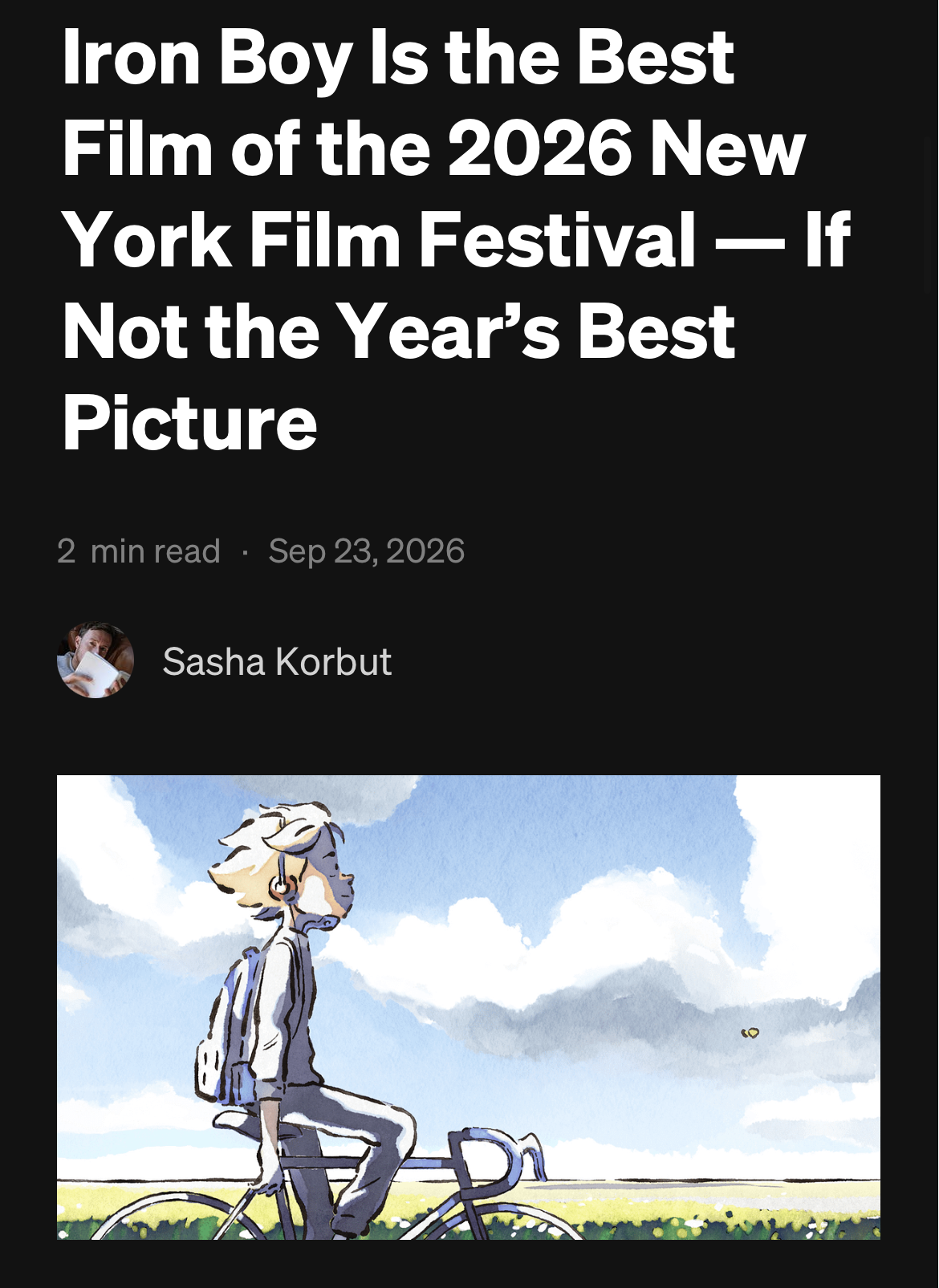
In recent years, only a few animated films have managed to go beyond the festival circuit and awards season to reach a mass audience. Probably the most famous is Flow, which won the César, Golden Globe, and Oscar, and there are lesser-known films such as Robot Dreams, Arco, and The Boy and the Heron, all of which are among my favorites.
This year, it’s Iron Boy — a hidden gem from French animator Louis Clichy, which is having its North American premiere at the New York Film Festival.
Set in the 1980s, it’s the story of Christophe, an 11-year-old farm boy living with his family in rural France. Christophe seems like a regular kid entering the coming-of-age stage of his life, yet there is something unusual about his neck: he can’t hold his head straight, always tilting it to the right or left, which makes him fall.
This unconventional circumstance becomes the core of the story, taking us through Christophe’s mundane life — from home to school, from the farm to church, and eventually to the discovery of music and its power…
Read the full review on Medium.com

If you are gay or live in LA, you probably know Firstman for his funny and witty Instagram and TikTok videos. He rose to internet fame during the pandemic, delivering impersonations of middle-class millennials, mostly living in LA. My personal favorite is his version of a straight man — in multiple cuts, Firstman simply says, “What?” Take a moment and watch it.
Yet Firstman’s acting and directing career started way before the algorithm did the work. He explored daddy issues in Call Your Father, a short film that he wrote and directed about a young gay guy struggling to date an older man in LA. Firstman later portrayed a version of himself in Sebastian Silva’s feature Rotting in the Sun and played multiple recurring gay roles in TV shows like I Love LA and English Teacher. His characters are often one-dimensional — they are horny, sexy, and gay.
When I’m at a queer party and mention Jordan Firstman’s name, gays often frown, saying that he is annoying or unlikable. It made me wonder whether they mean Jordan Firstman himself or the public persona he created, based on his own human flaws and fictional character traits. Perhaps we will never know. (It’s okay, I love the mystery.)
What I do know, though, is that Firstman’s directorial feature debut, Club Kid, puts him in the same line as up-and-coming and established quality-driven filmmakers. If you haven’t taken Jordan Firstman seriously before, you might reconsider.
Read more on Medium.com

In her directorial debut Stray, Christie explores bodily memory and how we carry it through time.
Read cover story on Medium

Kai Stänicke by Alex Karnyukhin at The Whitney Museum. 2026
After more than ten years in the making, Berlin-based German filmmaker Kai Stänicke has completed his first feature, Trial of Hein, now screening at the New Directors/New Films festival and emerging as one of the strongest feature debuts of the year.
Read full article on Medium

Nov 19, 2025
Earlier this year, I heard about a new documentary that immediately caught my attention — a Russian whistleblower exposing sweeping changes in schools following the invasion of Ukraine. Born and raised in Russia by a schoolteacher mother and a policeman father, I knew I had to see it, whether I was ready or not. I missed its Sundance premiere, where Mr. Nobody Against Putin won a Special Jury Award, and waited instead for its New York City debut at DOC NYC Film Festival last week.
The film takes place in Karabash, a small Russian town, just days after the invasion. Its central figure, Pavel “Pasha” Talankin, is a primary school teacher and school videographer tasked with documenting government-mandated changes to education. The footage was meant to remain internal. Instead, Pasha fled the country with multiple hard drives of material.
Directed by David Borenstein and co-directed by Pasha Talankin, the documentary exposes the power of propaganda and its harrowing impact on ordinary lives, especially children. Unsettling, heart-wrenching, and terrifying, it is also profoundly hopeful, asking the question: can one person’s actions against an oppressive system make a difference?
I met David and Pasha in New York the day after the premiere. Over coffee, we talked about their chance meeting, the risks they took to bring Mr. Nobody Against Putin to the world, and the consequences that followed.
Read full interview here

Ido Fluk by Alexander Karnyukhin
I fell in love with Keith Jarrett’s The Köln Concert long before I knew what it was. That melancholic, tender, and entirely improvised piano performance from his legendary 1975 concert in Cologne often surfaced on my playlists. When I finally learned its story — and later heard that a film about that legendary night was on the way — I immediately added it to my watchlist. Nearly a year after its Berlin Film Festival premiere, Köln 75, a new film by Brooklyn-based writer-director Ido Fluk, has finally arrived in New York City and is now playing at the IFC Center.
Köln 75 is not another biopic. Rather than focusing on Keith Jarrett, the obvious protagonist of the legendary performance, Fluk shines a spotlight on Vera Brandes, the 18-year-old promoter who made the concert happen. “No Vera Brandes, no Köln Concert,” Fluk states — and he makes it clear in Köln 75. If you haven’t heard her name before, you won’t forget it after watching the film. The inspiring story of Brandes — her relentless perseverance and ability to make the concert happen despite all obstacles — not only pays homage to her but also celebrates the work and effort of those often overshadowed by an artist’s fame.
The day after the North American premiere of Köln 75, Ido and I took a walk along McCarren Park in Brooklyn to talk about his creative approach to storytelling, directing style, and the decision to cast the enigmatic Mala Emde as Vera Brandes and the quietly intense John Magaro as Keith Jarrett.
Read full interview with Ido Fluk on Medium.com

Drunken Noodles Is the Hottest Queer Film at the New York Film Festival
In his third feature, writer/director Lucio Castro focuses on the exploration of queer sex, cruising culture, and the never-ending desire for more.
An interview with Lucio Castro
Photographed by Alexander Karnyukhin

19 Portraits During COVID-19
Essays

First Headshot
By Sasha Korbut.

Capturing a moment has become more important than experiencing it

One-night Kiss.
Based on a true smooch.

Barcelona — Zaragoza — San Sebastian — Cudillero — A Coruña — Madrid — Valencia.


Collected impressions from three days at America’s renowned film festival
Interviews

THE SOUND OF MOVIES. Carol sound designer Leslie Shatz
by Sasha Korbut for Filmmaker Magazine

“I had to tell this story no matter what”
ACT UP activist Vincent Gagliosto's directorial debut bridges the generational divide.
By Sasha Korbut for OUT magazine

From Russia with Loveless
Oscar nominated drama Loveless represents contemporary Russia. Or does it?